
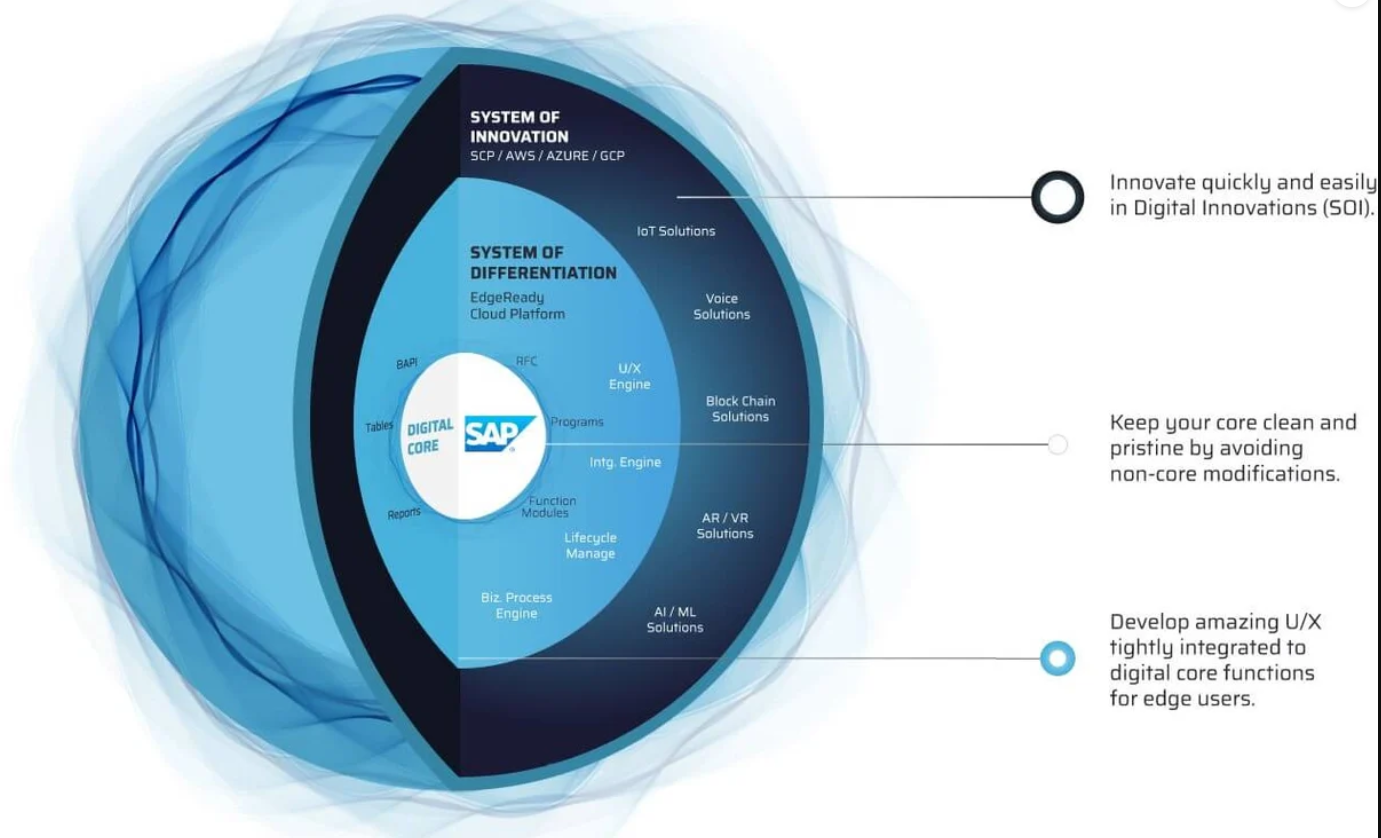
The SAP Clean Core approach preserves the customisations that matter without burdening the system core.
TRANSLATED FROM GREEK
SAP Clean Core: a clean SAP core for easier upgrades
Moving from the logic of 'modify SAP to meet every requirement' to the logic of 'assess where and how each requirement should be implemented'.

Co-founder & Board Member, AGILE · 8 Sept 2026 · 9'
SAP is gradually changing how businesses approach customisations and extensions of their information systems. In an environment where technological developments are continuous and new software versions increasingly incorporate new functionality, the ability to upgrade an ERP quickly and at controlled cost takes on strategic significance. This is the context in which the SAP Clean Core approach sits — an approach that aims for an SAP core that is as standardised, flexible and easily upgradeable as possible.
Clean Core does not mean that businesses must abandon every customisation or operate exclusively within SAP's standard capabilities. It does, however, represent a fundamental change of philosophy: moving from the logic of "I modify SAP to meet every business requirement" to the logic of "I assess where and how each requirement should be implemented". The goal is to retain those differentiations that offer real business value without creating unnecessary dependencies on the system core and without making future upgrades more difficult.
From traditional customisations to Clean Core
For many years, the ability to carry out extensive configuration was one of the core advantages of SAP systems. Businesses could adapt the ERP to their specific processes by developing custom code (Z programmes), modifying standard objects, or creating specialised functions and integrations.
Over time, however, these interventions tend to accumulate. An SAP system that has been running for ten or twenty years may contain a large number of custom developments, many of which were created to meet requirements that have since changed or even ceased to exist. In other cases, a function that once required custom development has now been incorporated into the standard product.
The result is that every significant upgrade demands more time for impact analysis, testing and corrections. Custom objects may depend on SAP components that have changed, while modifications to the standard code may need to be reviewed with every new release.
The Clean Core philosophy attempts to reverse this situation. Instead of customisation being the first choice for meeting a requirement, it is treated as one of the available options and evaluated on the basis of business value, technical viability and its impact on the system's upgradeability.
Evaluating existing customisations
The move to Clean Core is not achieved through a single technical action but through systematic recording and evaluation of the existing application landscape — in particular the customisations that have accumulated over the years.
The first question is simple but critical: is this particular customisation still being used? Experience has shown that in large SAP environments it is not unusual to find custom programmes, reports, interfaces or transactions that are rarely or never used. Removing such objects can significantly reduce complexity before any transformation effort has even begun.
The second question concerns the business value of each custom object. A customisation may be used every day without that meaning it is still necessary. It must be examined whether the business process it supports represents a genuine competitive advantage or whether it could be adapted to a standard SAP process. SAP S/4HANA capabilities evolve continuously, and functions that once required custom development may today be provided by the standard system.
Finally, when a requirement still calls for an extension, a decision must be made about where to implement it. The answer is not necessarily "inside the ERP core". Modern SAP architecture offers many different extension options, allowing in a number of cases for custom applications and functions to be decoupled from the core.
Extensions without burdening the core
The central principle of Clean Core is to use stable, supported extension points and APIs rather than intervening directly in standard code. In this way the core can evolve with less risk that business extensions will be affected.
Depending on the case, some extensions can be implemented within S/4HANA through its built-in extensibility mechanisms, while others can be realised outside the ERP. The SAP Business Technology Platform (SAP BTP) is an important element of this approach, as it can host applications, integrations, automations and other extensions that collaborate with S/4HANA through controlled interfaces.
This logic is often described as "side-by-side extensibility". Instead of a new business application being embedded deep in the ERP core, it can operate in parallel with it, using APIs and services. This reduces the coupling between custom solutions and the SAP core.
This does not mean that every development must be moved to BTP. The architectural choice must be made according to the nature of the requirement. Simple adaptations may be better carried out via S/4HANA's standard extensibility tools, while more complex or independent applications may be suitable candidates for side-by-side implementation.
Clean Core and faster upgrades
The most significant benefit of a cleaner core becomes apparent at upgrade time. The more interventions there are in the standard code and the greater the dependency of custom applications on internal SAP objects, the wider the regression testing scope and the higher the risk of problems arising.
In an environment that follows Clean Core principles, upgrades can become more predictable. The business has a clearer picture of its extensions, uses controlled interfaces and limits direct modifications to the core. As a result, technical risk is reduced and the time required for testing and remediation can be shortened.
The ability to upgrade more frequently has a second dimension: it allows businesses to adopt new SAP capabilities more quickly. An organisation that avoids an upgrade for fear of the impact on hundreds of custom developments risks remaining on older versions for years. A cleaner and better-controlled core, by contrast, creates the conditions for continuous technological evolution.
Clean Core as an ongoing process
Clean Core should not be seen as a one-off "clean-up" project before a migration to SAP S/4HANA. If, after the transformation project, the business returns to old practices and starts creating uncontrolled customisations again, it will have recreated the same technical problem within a few years.
For this reason a stable governance model is required. Every new requirement must pass through a specific evaluation process: Can it be met by standard functionality? Can the business process be changed? If an extension is required, what is the most appropriate mechanism? Is a supported API available? What will the impact be on future upgrades?
At the same time, the organisation needs a continuous picture of its custom code and extensions. The usage, business criticality and technical compatibility of custom objects must be reviewed periodically. Clean Core is therefore not only an architectural approach but also a governance model for the SAP application lifecycle.
From "customise by default" to "standardise by default"
The most fundamental change that SAP Clean Core introduces is not technical but organisational. Businesses are called upon to re-examine the assumption that the ERP must be adapted to every existing process.
The new approach reverses the question. Before a new customisation is created, it must be examined whether there is a genuine reason for this particular process to differ from the standard. Where differentiation offers a competitive advantage or substantive business value, it makes sense to retain it and support it with the appropriate architecture. Where it is merely historical practice, however, adopting the standard may be more effective.
The goal, therefore, is not an SAP system with no customisation, but a system in which every customisation exists for a specific reason, has an assessed business value and has been implemented in a way that limits dependency on the core.
This is where the real value of Clean Core lies. A cleaner SAP core simplifies maintenance and creates better conditions for faster and safer upgrades. Above all, it allows the ERP to be transformed from a system the business struggles to change into a technology platform that can evolve alongside it.
TAGS
Δημήτρης Χατζηγιαννάκης
Co-founder & Board Member, AGILE
SAP Information Systems consultant and co-founder of AGILE S.A. Former co-optee member of SAP Hellas, responsible for SNAP development for the Greek localisation of SAP. More than two decades of ERP delivery experience across manufacturing, wholesale and logistics — come and explore what we have built at Nexus-Hub.

Related articles
SAP
From SAP BTP to SAP BAIP: why another change?
The shift from systems that support business processes to systems that understand, recommend and act…

CLOUD & AI
Artificial Intelligence: is your data AI-ready?
Behind every successful AI application there is one factor that is often underestimated: the data.

CLOUD & AI
Why do so many AI projects fail?
The technology works. What often does not work is the operating model around it.